
Core Gameplay Loop
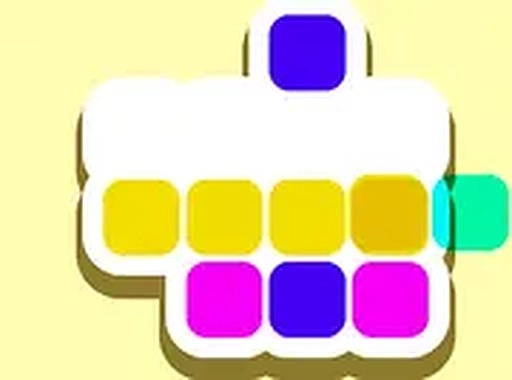
Players take turns dragging blocks onto a square board. Each block has a single color, and the goal is to arrange them so that three identical hues line up horizontally or vertically. When a match is made, those blocks vanish, freeing up space. The challenge escalates as the board fills and new blocks arrive with increasing speed.
Stacking and Color Creation
A distinctive twist is the ability to place a block directly on top of another. This merges their colors into a new shade based on real-world color theory. For example, placing a yellow block on a blue one produces green. This allows players to intentionally create matching sets, but also introduces risk: stacking too many times on one tile can cause it to disappear permanently, and mixing to a dark shade makes that tile unmatchable.
Strategic Depth and Risk Management
Success depends on forward planning. Each placement affects future options, and the permanent dark tiles force players to work around obstacles. Rotating larger blocks with the mouse wheel helps fit them into tight spots. The game rewards careful thought over speed, making each session a test of spatial reasoning and color logic.
Accessibility and Session Design
Designed for quick plays or extended sessions, the game runs entirely in a web browser with no installation. Controls are simple: drag to place, right-click or scroll to rotate. The rules are easy to grasp within a minute, but mastering the color mixing and board management takes practice. This makes it suitable for casual players and puzzle enthusiasts alike.




Comments
0 comments